Evaluating Mona Home for Holiday Design Projects
In the realm of digital typography, few categories are as specific yet as demanding as holiday-themed typefaces. Designers often struggle to find fonts that balance festive cheer with professional readability. Mona Home emerges as a significant contender in this niche, offering a distinct blend of whimsical flair and structural integrity. As a festive and merry typeface, it is engineered to capture the spirit of the holiday season without descending into illegible clutter. For professionals ranging from graphic designers to small business owners, understanding the practical application and technical capabilities of Mona Home is essential for integrating it effectively into seasonal campaigns.
The Aesthetic Identity of Mona Home
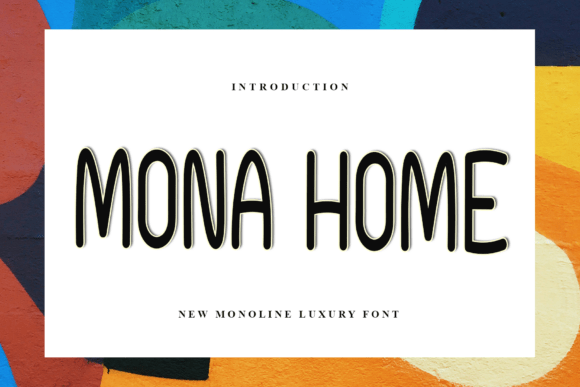
The primary value proposition of Mona Home lies in its ability to evoke nostalgia while maintaining a modern decorative standard. Unlike many generic script or display fonts that rely on excessive flourishes to convey "festivity," Mona Home utilizes a carefully curated set of decorative elements. These embellishments are not merely random; they are designed to complement the letterforms, adding a touch of enchantment that feels organic rather than forced. The font's character stems from its rounded terminals and playful ascenders, which mimic the hand-lettered style often seen on vintage greeting cards and artisanal gift tags.
When evaluating the visual weight of the typeface, one notices a deliberate contrast between thick and thin strokes. This variation creates a dynamic rhythm that keeps the eye engaged, even when reading longer phrases like holiday greetings or short promotional copy. The design avoids the trap of looking overly cartoonish, making it suitable for audiences aged 20 to 50 who appreciate quality aesthetics. Whether used for a boutique bakery's Christmas menu or a corporate holiday newsletter, Mona Home brings a cheerful ambiance that aligns with the emotional tone of the season.
Technical Architecture: PUA Encoding and Glyph Access
A critical differentiator for Mona Home is its technical implementation, specifically its use of Private Use Area (PUA) encoding. In the world of digital typography, accessing special characters, ligatures, and alternative glyphs can often be a friction point for designers. Standard Unicode slots are limited, forcing many foundries to hide their most creative assets behind complex workarounds or separate symbol layers. Mona Home solves this by leveraging PUA encoding, allowing users to access all amazing glyphs and ligatures with ease directly within their design software.
This architectural choice has profound implications for workflow efficiency. When working on time-sensitive holiday projects, the ability to pull up a snowflake, a holly berry, or a specific ligature combination without navigating external plug-ins or manual kerning adjustments is invaluable. The PUA structure ensures that these decorative elements are treated as integral parts of the font file, maintaining consistency across different operating systems and applications. For freelancers and agencies managing multiple clients, this reliability reduces the risk of missing characters or broken links during the final export process.
Practical Application of Ligatures and Alternates
The inclusion of extensive ligatures in Mona Home allows for a level of customization that static fonts cannot match. Ligatures are combinations of two or more letters that merge into a single glyph, improving the flow and legibility of the text. In a decorative context, they also serve an aesthetic function, creating unique visual moments that break the monotony of standard letter spacing. With Mona Home, these features are accessible through simple keyboard shortcuts or OpenType feature toggles, depending on the software environment.
For example, a designer creating a header for a holiday sale might use a specific ligature to connect the "H" and "o" in "Home," creating a seamless, flowing shape that draws attention. Similarly, the availability of alternate glyphs means that no two instances of the font need look identical. This flexibility is particularly useful for branding projects where uniqueness is paramount. It allows creators to let their typography shine with the magic of Beautiful Font principles, ensuring that every project feels bespoke and thoughtfully crafted.
Real-World Performance and Usability
While the aesthetic appeal of Mona Home is evident, its true worth is measured in real-world performance. How does it hold up when scaled down for a gift tag versus blown up for a storefront banner? Testing reveals that the font maintains its structural integrity across a wide range of sizes. At smaller points, the decorative elements do not become muddy or indistinguishable, preserving the clarity necessary for readability. At larger scales, the curves remain smooth and the details sharp, making it ideal for large-format prints and signage.
However, like any display typeface, there are limitations regarding body text. Mona Home is not intended for long-form paragraphs or dense informational content. Its decorative nature demands white space and careful layout planning. Attempting to use it for extended prose will likely result in visual fatigue for the reader. Therefore, its optimal use cases are strictly defined: headlines, subheads, short slogans, and decorative accents. Professionals should view Mona Home as a specialized tool within their arsenal, perfect for specific tasks but not a universal solution for all typographic needs.
Ideal Use Cases and Audience Fit
The versatility of Mona Home makes it a strong asset for several specific demographics. Entrepreneurs running small businesses, particularly in the retail, food, and craft sectors, will find immediate value in this font. It is perfectly suited for creating packaging labels, holiday menus, and social media graphics that require a warm, inviting tone. For marketers, the font offers a way to differentiate seasonal campaigns from competitors who may rely on overused stock imagery and generic typefaces.
- Greeting Cards: The nostalgic ambiance of Mona Home enhances the personal feel of handmade or digital greeting cards.
- Gift Tags: Its compact yet decorative forms fit well on small surfaces without losing impact.
- Holiday-Themed Projects: From event invitations to website banners, the font provides a cohesive visual theme.
- Branding Accents: Businesses can use it for temporary seasonal rebranding efforts without compromising their core identity.
Bloggers and content creators also benefit from the font's ability to add visual interest to headers and call-to-action buttons. In an era where digital engagement is driven by visual cues, a well-chosen typeface can significantly increase click-through rates and user retention. The cheerful and nostalgic ambiance that Mona Home brings to words can subtly influence the reader's mood, making the content feel more approachable and festive.
Quality, Consistency, and Long-Term Value
From a quality assurance perspective, Mona Home demonstrates a high level of consistency. The spacing between characters is meticulously adjusted to ensure that the decorative elements do not interfere with the overall rhythm of the text. This attention to detail suggests a robust development process, reducing the likelihood of kerning issues that often plague lesser-known fonts. Reliability is further enhanced by the PUA encoding, which ensures that the font behaves predictably across various design platforms.
Regarding long-term value, investing in a font like Mona Home pays dividends through its adaptability. While it is inherently tied to the holiday season, its underlying design principles—whimsy, warmth, and decoration—are timeless. With minor adjustments or creative pairing with neutral sans-serif fonts, elements of Mona Home can be repurposed for other celebratory occasions, such as birthdays, weddings, or spring festivals. This extends the utility of the asset beyond a single quarter, providing a better return on investment for designers and businesses alike.
Professional Recommendations and Limitations
To maximize the effectiveness of Mona Home, designers should adhere to a few key guidelines. First, always pair it with a clean, neutral typeface for body copy. This contrast ensures that the decorative elements of Mona Home stand out without overwhelming the viewer. Second, utilize the PUA-encoded glyphs strategically; do not overuse them to the point of visual noise. Selective application creates emphasis and guides the reader's eye to key information.
It is also important to acknowledge potential limitations. Because the font relies on PUA encoding, compatibility with certain older or non-standard software environments may require testing. Users should verify that their specific design tools support PUA characters before committing to a major project. Additionally, the font's whimsical nature may not align with brands that prioritize minimalism or corporate seriousness. In such contexts, Mona Home could appear incongruous unless used very sparingly as a subtle accent.
Ultimately, Mona Home represents a thoughtful addition to the typographic landscape. It addresses the specific needs of holiday design with a balance of charm and technical sophistication. By offering easy access to a rich library of glyphs and maintaining high standards of legibility and consistency, it empowers creators to produce work that resonates emotionally with their audience. For those seeking to elevate their seasonal projects with a font that truly captures the magic of the holidays, Mona Home is a compelling and reliable choice.